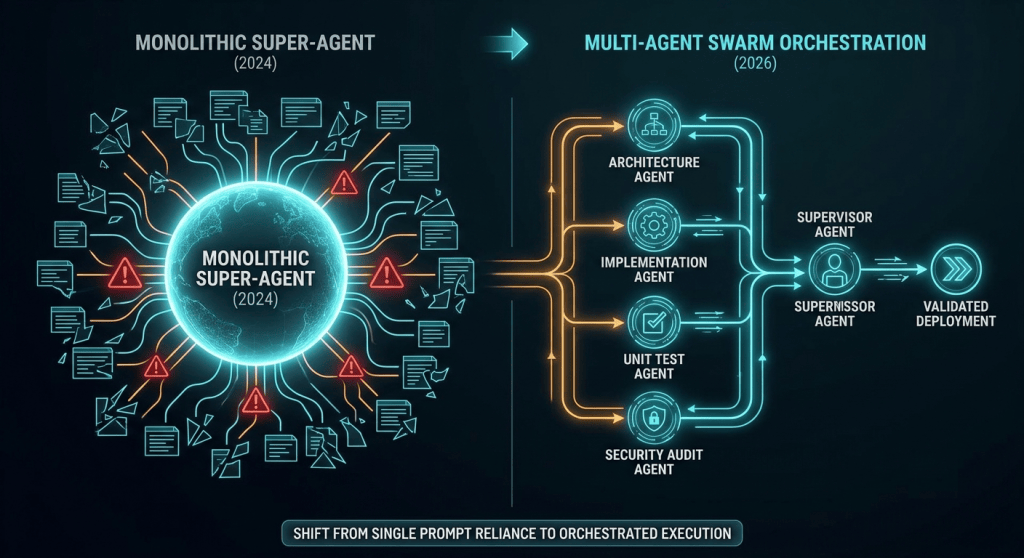
Over the past three years, enterprise software teams fell into a predictable trap: the search for the perfect prompt. Organizations attempted to build monolithic “Super-Agents”—single large language model instances tasked with parsing complex context, executing code, interfacing with external APIs, and validating output all at once.
The result in production was inevitable: high hallucination rates, severe context drift, massive token costs, and catastrophic failures when handling complex, non-linear business processes.
By 2026, enterprise IT reached a clear consensus: the “do-it-all” agent is obsolete.
Instead of forcing one model to master every task, forward-thinking organizations are adopting role-based Multi-Agent Systems (MAS). By breaking massive enterprise workflows into narrow, specialized sub-tasks assigned to dedicated autonomous agents, companies are seeing a fundamental shift in reliability, speed, and auditability.
+-------------------------------------------------------------------------+| THE ARCHITECTURAL PARADIGM SHIFT |+-------------------------------------------------------------------------+| Monolithic Agent (2024): Single Prompt -> Context Bloat -> Fragile || || Multi-Agent Swarm (2026): Supervisor -> Router -> Specialists -> Audit |+-------------------------------------------------------------------------+
The Architectural Matrix: Monolith vs. Multi-Agent Swarm
The structural advantages of replacing single agents with orchestrated swarms touch every layer of performance:
- Context Isolation: A specialized retrieval agent only sees context relevant to its domain, preventing context window bloat and prompt injection bleed.
- Model-Task Optimization: Compute costs drop drastically when organizations pair lightweight, fast models for basic tool calling with heavy reasoning models reserved purely for complex synthesis or supervisory review.
- Fail-Safe Redundancy: If a single agent in a swarm fails to parse an API payload, localized retry logic isolates the error without crashing the entire business process.
+-----------------------+----------------------------------+------------------------------------+| Dimension | Monolithic Super-Agent | Multi-Agent Swarm |+-----------------------+----------------------------------+------------------------------------+| Task Distribution | Single prompt handles end-to-end | Narrow tasks assigned to experts || Model Usage | One heavy LLM for all operations | Right-sized LLMs per specialized role|| Failure Radius | Process crashes on step failure | Localized retry & fallback loops || Context Management | Fragile, high token consumption | Isolated, domain-specific state |+-----------------------+----------------------------------+------------------------------------+
Strategic Takeaways for new-gen tech leaders
- Stop Prompt Engineering, Start System Designing: Shift your focus from refining single prompts to mapping handoffs between narrow agents.
- Define Role Boundaries: Assign clear inputs, tools, and outputs to every agent in the ecosystem—just as you would manage a human engineering team.
 BlogAdda
Leave a comment