The Interoperability Crisis
As enterprises deploy specialized agents across sales, finance, engineering, and support, they quickly hit a new operational barrier: siloed agent stacks.
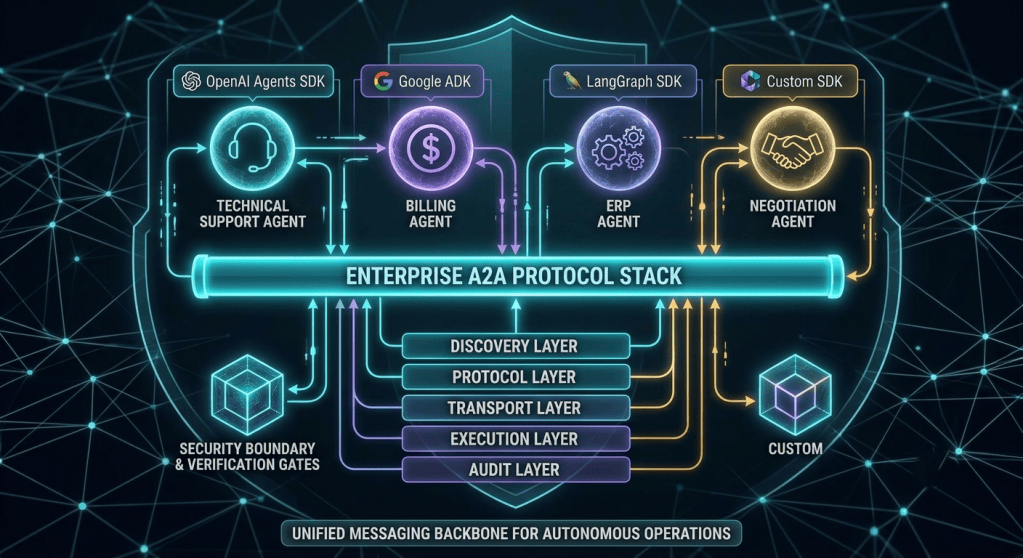
An agent built on OpenAI’s Agents SDK for customer support cannot natively communicate with a financial reconciliation agent running on Google ADK or LangGraph without standardized messaging layers.
Without standardized Agent-to-Agent (A2A) communication, companies end up writing brittle, custom API wrappers between every single agent—creating the exact same integration tax that crippled legacy microservices.
[ Sales Agent (OpenAI) ] <--- Handcrafted Code ---> [ Billing Agent (LangGraph) ] | ( BRITTLE INTEGRATION ) |[ Support Agent (CrewAI) ] <--- Handcrafted Code ---> [ ERP Agent (Custom) ]
The Standardized Communication Stack
Modern multi-agent architectures solve this challenge using a clear, layered communication framework that handles discovery, state management, and intent routing across distinct agent systems:
+------------------------------------------------------------------------+| ENTERPRISE A2A PROTOCOL STACK |+------------------------------------------------------------------------+| Discovery Layer : Universal Agent Registries & Capability Mapping || Protocol Layer : Model Context Protocol (MCP) & A2A Schemas || Transport Layer : Stateful Event Brokers (Kafka, Redis Checkpoints) || Execution Layer : Cyclical State Control & Handoff Primitives |+------------------------------------------------------------------------+
Key Mechanics of Inter-Agent Communication:
- Capability Discovery & Handshakes: Before initiating a workflow, agents query central registries to identify available peer capabilities, verifying system permissions before delegating subtasks.
- Deterministic Message Buses: Communication relies on structured, event-driven payloads rather than informal natural language prompts, guaranteeing schema compliance across execution points.
- Stateful Checkpointing: Enterprise orchestration engines maintain persistent state logs (e.g., PostgreSQL or Redis backends), enabling time-travel debugging and pause-and-resume capabilities if an agent run stalls.
+-----------------------+----------------------------------+------------------------------------+| Integration Metric | Legacy API Integration | Modern Agentic Protocol Layer |+-----------------------+----------------------------------+------------------------------------+| Tool Standard | Custom REST / GraphQL endpoints | Model Context Protocol (MCP) || Handoff Logic | Hardcoded conditional scripts | Dynamic intent-based handoffs || Interoperability | Vendor-locked ecosystem | Cross-framework A2A protocols || State Control | Stateless requests | Stateful cyclical execution graphs |+-----------------------+----------------------------------+------------------------------------+
- Adopt Open Protocol Standards: Prioritize frameworks that support Model Context Protocol (MCP) and cross-framework A2A tools to avoid vendor lock-in.
- Separate Control Plane from Data Plane: Ensure your orchestration layer monitors policies and authorization independently from raw message routing.
 BlogAdda
Leave a comment