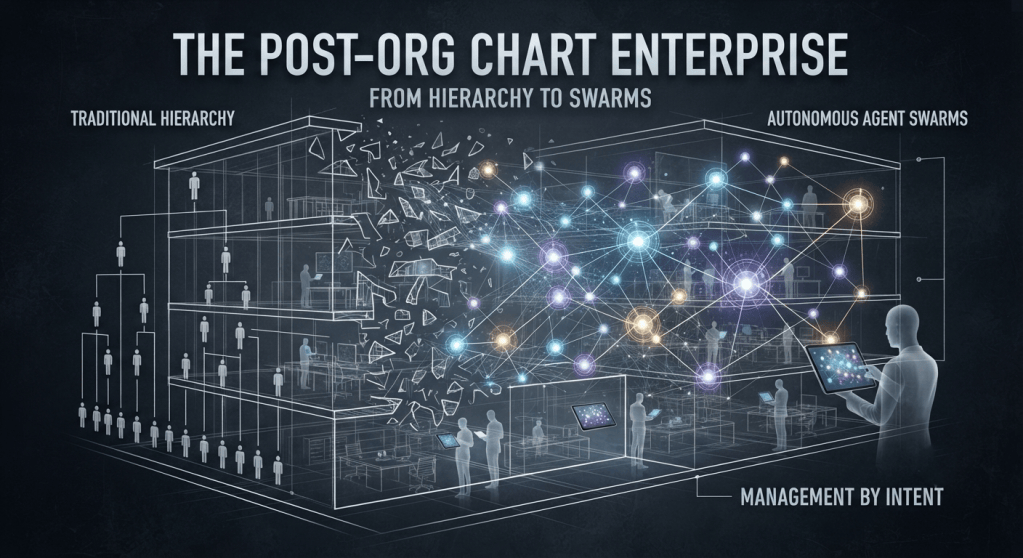
We spent decades optimizing the middle management layer for one simple reason: humans need translation, coordination, and context-sharing to move fast. When your primary workforce shifts to autonomous, communicating agent swarms, that entire organizational topology collapses.
If Part 1 looked at the Agentic Friction Layer and Part 2 explored AI-to-AI communication, Part 3 is where the rubber meets the road: How do engineering and ops leaders actually build, manage, and govern a post-org chart enterprise?
Here is a pragmatic playbook for making the transition:
- Shift from “Direct Management” to “Intent Governance”: Write hard boundaries, budgets, and guardrails instead of rigid SOPs. You aren’t managing tasks anymore; you are writing the constitution under which swarms operate.
- Redefining the “Manager” Role: Technical leads spend less time writing code and more time acting as constitutional architects—focusing on drift detection and exception handling.
- Asynchronous Execution Requires Synchronous Trust: Trust isn’t built on team-building exercises; it’s built on verifiable lineage, with immutable logs tracking why an agent made a decision.


Leave a Reply