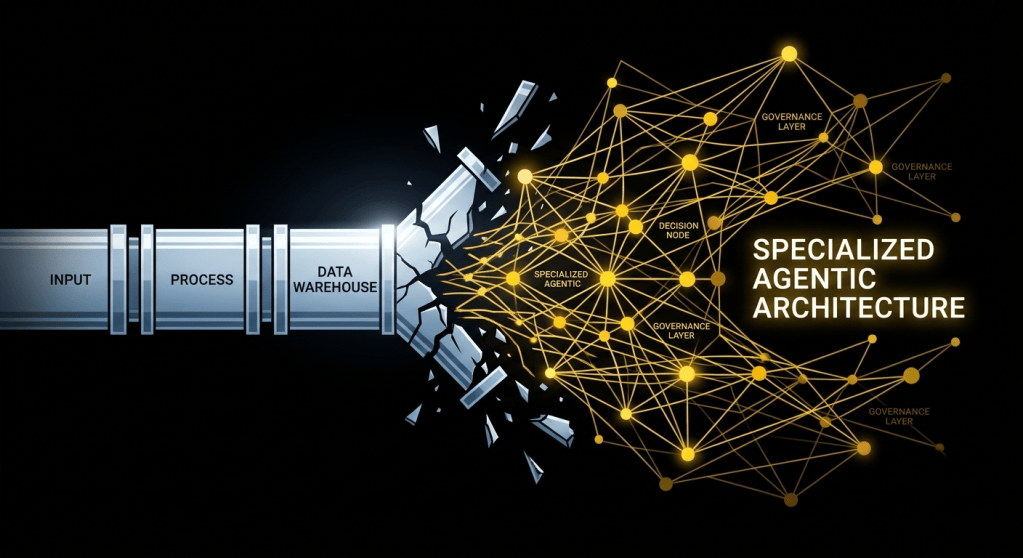
The promise of enterprise AI was supposed to be acceleration, yet we’ve arrived at a paradoxical bottleneck. Companies that have successfully deployed large language models (LLMs) are discovering a new barrier—not in the models themselves, but in the environment they inhabit.
We are entering the era of The Agentic Friction Layer.
The SOP Problem in an API World
For the last twenty years, enterprise digital transformation has been defined by two distinct forces moving in parallel:
- System-to-System APIs: Standardized interfaces that theoretically allow application A to talk to application B.
- Human SOPs: Standard Operating Procedures, the unstructured text documents that describe exactly how a human must manipulate Application B after reading data from Application A.
We built APIs for deterministic execution, but we kept the process logic buried in human brains and PDF manuals. This is the Agentic Friction Layer. It’s the gap where specialized human knowledge worker interpretation is required to navigate ambiguity that APIs cannot manage alone.
Specialized Workflows, Not General Models
The mistake of the early 2020s was treating the LLM like a magic black box: an input-output system where you put unstructured requests in and get execution out. Enterprise execution doesn’t work that way. It requires deterministic boundaries, security guardrails, and business context.
The solution to agentic friction is not a bigger, general LLM. It is specialized, autonomous AI workflows.
If you ask a general LLM to “onboard a new employee,” it will fail. Why? Because employee onboarding requires twenty-five different data transfers across five systems, plus four different policy interpretations regarding equipment, background checks, and team placement.
When you deploy a specialized onboarding agent workflow instead, you’ve built a system that:
- Negotiates schemas: It understands that the HR system defines “EmployeeID” as a string while the IT provisioning system defines it as an integer, and it manages the cast without breaking the pipeline.
- Resolves Ambiguity: When the background check result returns a deterministic state of “Flagged (Awaiting Interpretation),” the agent understands it must pause, preserve context, and route to a human compliance officer before resuming—something no traditional API or general LLM can do reliably.
Pragmatic Takeaways for Infrastructure Leaders
To remove agentic friction and transition toward specialized agent workflows, engineering and ops leaders must prepare the technical substrate:
- observ-ability of Intent: We are excellent at observing state (the server is up, the query is fast). We are bad at observing intent. Your agentic infrastructure must log not just the data exchanged, but the non-deterministic reasoning chain used to make the operational decision.
- Verifiable Lineage: Every autonomous decision must have an immutable audit trail. When the automated pricing agent adjusts thousands of quotes, you must be able to verify that the price change was compliant with intent governance, triggered by the correct market signals, and not caused by model hallucinations.
- Schema Flexibility: Your middleware can no longer be based on rigid, fragile REST contracts that break upon slight change. The defining characteristic of the next-generation enterprise bus is its ability to dynamically adjust to the data contracts required between autonomous specialized agents.
The true definition of a “modern tech stack” is no longer defined by its cloud provider, but by how much human interpretation is required between systems. The Agentic Friction Layer is the last barrier to true automation. It’s time to build past it.


Leave a Reply