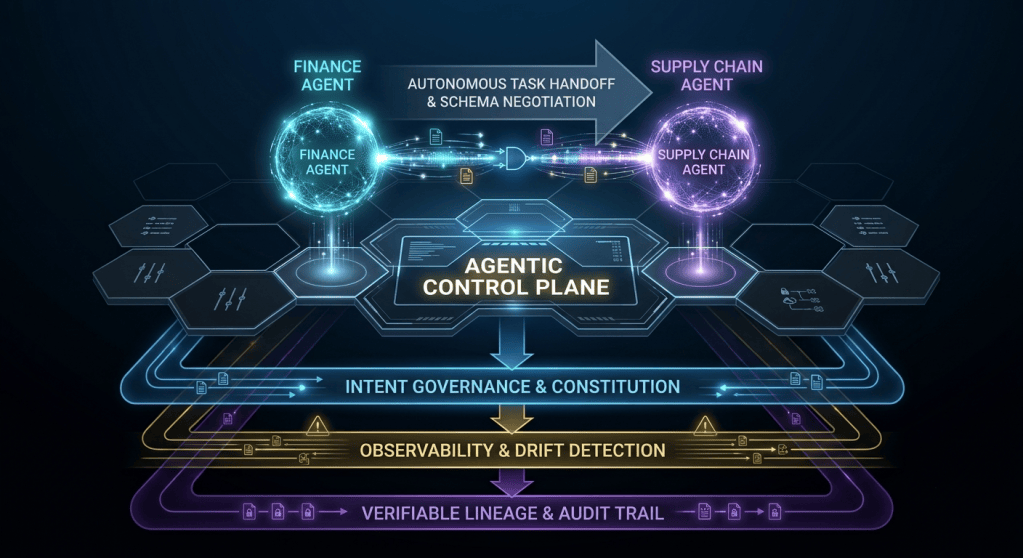
The initial wave of enterprise AI adoption was largely focused on copilot paradigms: a human sits at a keyboard, prompts a model, reviews the output, and pastes it into another enterprise application. While this yields incremental productivity gains, it creates a new operational bottleneck: the human operator as a manual message broker.
As enterprise architecture scales, the real paradigm shift occurs when we remove the human from the routine transaction path and enable direct AI-to-AI communication.
From Monolithic LLMs to Specialized Swarms
Early enterprise AI implementations often tried to build a “god model”—a massive, central LLM expected to handle everything from financial compliance to customer support tickets. In practice, this approach falls short due to high context-window overhead, latency, and unpredictable reasoning across disparate domains.
The modern paradigm shifts toward decentralized multi-agent swarms:
- Hyper-Specialization: Instead of one omniscient model, enterprises deploy lightweight, domain-specific agents (e.g., a Procurement Agent, a Compliance Agent, and a Vendor Negotiation Agent).
- Autonomous Handoffs: When a supply chain disruption occurs, the Logistics Agent does not merely alert an operator; it immediately emits a structured payload to the Procurement Agent to explore alternative routes and suppliers.
- Context Preservation: Specialized agents pass isolated, state-specific context packages rather than giant, noisy prompt histories, dramatically reducing latency and compute costs.
The Emerging Agentic Control Plane
When agents interact directly, traditional API gateways and middleware are no longer sufficient. Classic REST APIs require rigid, predefined schemas. If Application A changes an parameter, Application B fails until an engineer writes a patch.
Agent-to-agent communication requires a dynamic Control Plane capable of:
- Dynamic Schema Negotiation: If the Finance Agent requests vendor data formatted in a legacy JSON structure, the Vendor Agent dynamically casts its data output to match without breaking the transaction pipeline.
- Intent Verification: Before an agent executes a call on another agent’s endpoint, the control plane validates that the request aligns with business constraints and security permissions.
- Loop Detection & Termination: Autonomous agents communicating asynchronously can accidentally trigger infinite loops (e.g., two negotiation agents endlessly counter-offering). The control plane enforces circuit breakers based on depth, budget, and time-to-live (TTL) metrics.
Pragmatic Guidance for Engineering & Ops Leaders
To transition from static human-in-the-loop systems to an agentic ecosystem, focus on these tactical priorities:
- Shift Metrics to Convergence Time: Stop measuring individual model latency in isolation. Track Contextual Convergence Time—the total duration it takes for two or more agents to negotiate an agreement, validate constraints, and execute an enterprise transaction.
- Implement Cryptographic Lineage: Every agent-to-agent handoff must leave an immutable trail. Track which prompt template, context window, and model weights generated the request, and which policy authorized the receiving agent to execute it.
- Design for Deterministic Exception Handling: Agents should resolve routine ambiguity autonomously, but they must have clear, deterministic thresholds for when to escalate to human oversight. Human-in-the-loop shouldn’t be the default execution path; it should be the ultimate exception handler.
When your enterprise systems begin conversing, negotiating, and executing autonomously behind the scenes, operational speed ceases to be limited by human throughput.


Leave a Reply