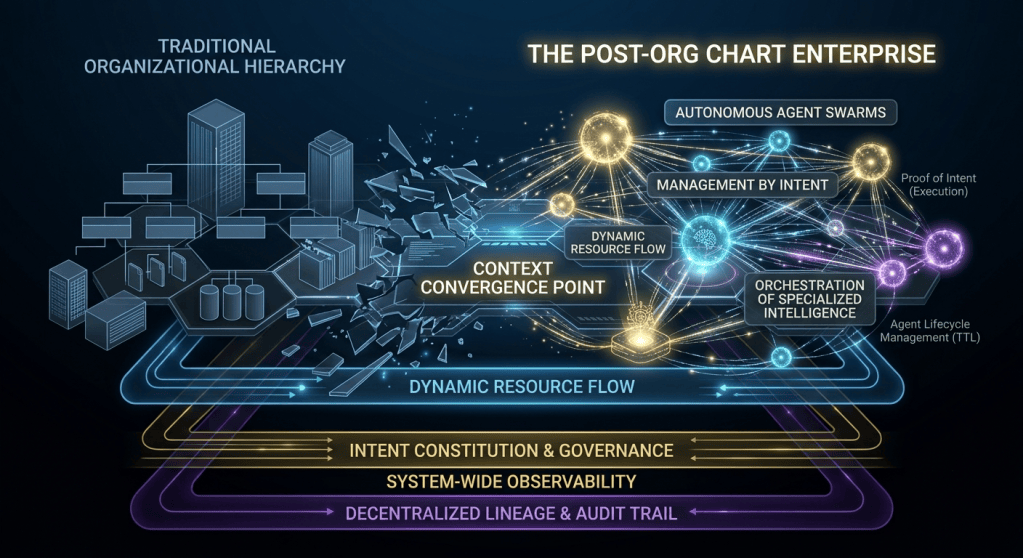
For over a century, the corporate org chart has served as the default blueprint for enterprise operations. Nodes represented managers, edges represented reporting lines, and departments functioned as functional silos designed to control the flow of information and human execution.
However, as we dissolve the agentic friction layer (Part 1) and establish dynamic AI-to-AI communication planes (Part 2), a fundamental realization emerges: the traditional organizational topology is an inefficient bottleneck for autonomous workflows.
We are now stepping into The Post-Org Chart Enterprise.
From Command-and-Control to Swarm Topology
When tasks require human manual assembly, vertical hierarchy makes sense. Information moves up for approvals and down for execution. But when autonomous AI swarms execute complex multi-system operations in seconds, rigid departmental structures slow down the system.
In a post-org chart structure, enterprise capability moves from static divisions (Marketing, Procurement, IT) to fluid, goal-oriented agent swarms:
- Dynamic Resource Allocation: Instead of assigning headcount to fixed yearly budgets, execution capacity dynamically expands and contracts. Compute resources flow directly to the agent swarms currently tackling high-priority business outcomes.
- Flattened Operational Paths: Functional handoffs no longer require cross-departmental alignment meetings. An operational need expressed at the strategy level triggers cross-functional execution simultaneously across finance, supply chain, and compliance agents.
- Asynchronous Execution: Human managers move away from tracking task completion in ticketing systems. Swarms operate asynchronously, converging on solutions and presenting completed work or high-level strategic exceptions.
Management by Intent: The New Leadership Framework
If leaders are no longer managing human task lines or reviewing every intermediate deliverable, what becomes of enterprise leadership?
The shift requires moving from Standard Operating Procedures (SOPs) to Management by Intent:
- Defining the Agentic Constitution: Rather than writing 50-page training manuals, engineering and business leaders establish hard boundaries, ethical frameworks, and non-negotiable operational rules—the “constitution” that governs agent decision-making.
- Setting Objective Functions: Leaders define precise metrics and constraints (e.g., “Optimize logistics for delivery speed, provided margin remains above 18% and carbon emissions stay within quarterly caps”).
- Architecting System Boundaries: Executives focus on boundary conditions, budget allocations, and system permissions—ensuring agents have enough context to operate independently while remaining bounded by organizational risk tolerance.
Pragmatic Roadmap for Enterprise Leaders
To transition your organization toward a post-org chart operating model, consider these foundational steps:
- Redefine the Role of Middle Management: Re-skill team leads from human task coordinators to Agentic Systems Architects. Their job is to design, monitor, and optimize the workflows executed by autonomous swarms.
- Shift from Seat-Based to Compute-Based Metrics: Align enterprise software and operational budgets with agent compute, convergence time, and value delivered, rather than static headcount or SaaS seat licenses.
- Establish Human-in-the-Loop Thresholds: Map out clear exception paths. Humans should intervene only when an agent swarm encounters out-of-bounds ambiguity, regulatory edge cases, or systemic anomalies.
The enterprise of the future won’t be defined by how many people report to a Vice President, but by how effectively human vision can be translated into autonomous, scalable agentic execution.


Leave a Reply